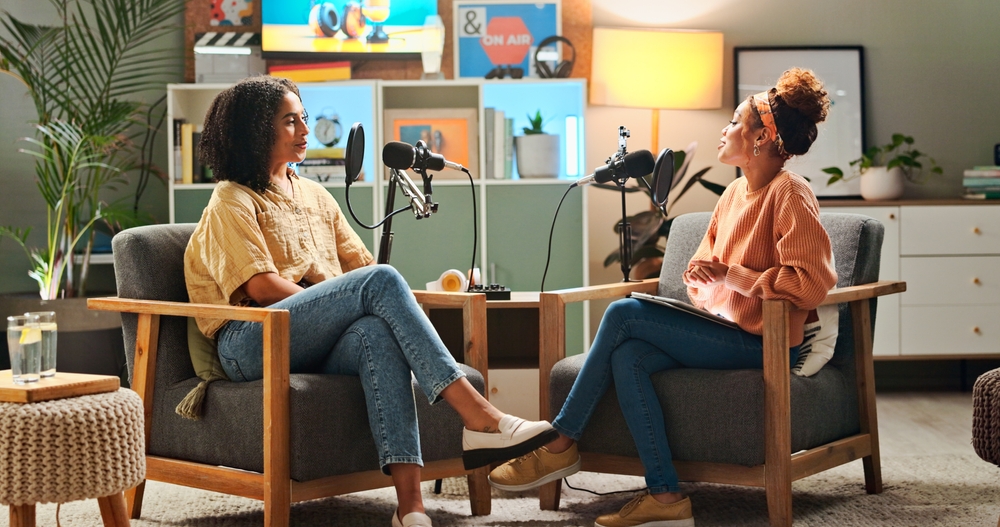
Whether traditionally published or self-published, all authors need to set aside time to figure out how to cultivate an audience and promote their books, which is not necessarily what they enjoy or are good at. Authors typically prefer the solitude of writing to public speaking. Clients tell me, “Wait, what? I’m not a salesperson!” The reality is that in today’s publishing world, you might have to be! Here’s why: Publishing houses have small or no marketing departments. In recent years, marketing one’s book has only become more challenging due to algorithm changes, a crowded marketplace, and declining ad performance. Successful marketing is less about generating immediate sales and more about building a loyal readership through thoughtful optimization, community engagement, and local outreach. Call it sales, infotainment, or public speaking—getting the word out requires a new role for authors, and podcasts are a great way to do so
Fortunately, there are many podcasts that focus on authors and can extend your potential readership in ways you couldn’t achieve alone. In this blog post, dedicated to authors, I’ll share some strategies for finding podcasts that are a good fit for your book and your desired readership.
Do Your Homework
Most of us are used to political podcasts tied to major news sources like The New York Times or monthly magazines like The Atlantic, but there are podcasters who regularly interview authors. Authors would be wise to find podcasters whose audiences match their target readership. Ask yourself: Are their listeners young adult readers, rom-com addicts, or mystery lovers?
A few podcasters who interview authors include:
- Between the Covers: Hosted by David Naimon and produced by Tin House.
- First Draft: A Dialogue on Writing: Hosted by Mitzi Rapkin.
- The Book Review: Produced by The New York Times.
- Electric Literature: Features podcasts with authors, poets, and book enthusiasts.
- Katie Couric Book Club: A reading community founded by the renowned journalist.
- Penguin Debut Authors Book Club: Dedicated to first-time authors.
Once you find a good fit, contact the podcasters and indicate your interest in being interviewed. In your pitch email, include a summary about your book and a list of talking points. Suggest topics you are prepared to discuss based on your expertise or unique background and that would be interesting to their specific listeners. Once you receive an invitation, you need to prepare yourself for a lively conversation that will be recorded and available on the web for posterity. Preparation is no casual endeavor!
Before the Author Interview, Prepare Your Content
Keep in mind the old saying, “Proper preparation prevents poor performance.” Take some time to organize your key message points in advance so the words roll off your tongue. One of the podcaster’s inevitable questions will be, “What is the book about?” I’ve prepared authors and have been shocked by their answers, which usually begin with, “Uh….” Be ready to:
- Describe your characters, the plot, themes, and setting.
- Explain why you wrote the book. What was your motivation?
- Describe your writing process—listeners love to hear from authors about this!
- Explain why you think your book is relevant in today’s world and to your target audience.
Before the Author Interview, Know What You Sound Like
I’ve had clients tell me they had no idea what they sounded like until they listened to their interview afterward. It was a rude awakening to hear their nasal tone of voice, uptalk, vocal fry, or overuse of the word “like.” Some interviewees also end sentences with the word “Right?” which can be overused and signal a need for agreement that might not even exist.
You can avoid the “morning-after blues” by preparing yourself the way a runner prepares for a marathon. Arrange to role-play the interview with a friend the day before and provide them with a list of the key questions you’re likely to be asked. While you’re preparing, make sure your website is ready for the traffic your interview may generate. Your “Buy” links should be easy to find, and you might even consider creating a special offer for podcast listeners.
On the day of your podcast interview, make sure you set yourself up for success in every way. You’ll need a quiet and pleasant environment without distractions such as barking dogs, noisy traffic, or unexpected interruptions—like the famous BBC interview when the journalist’s wife and kids entered the screen. Set up a Zoom with a friend to test all your technology, ensuring your sound quality is clear and crisp. If it’s a video interview, make sure you show up camera-ready.
During the Interview
The interview is a conversation! You need to relate to and connect with the podcaster. Listen intently to their questions. Respond by nodding, smiling, and connecting to what’s being said. If you’re on video, use public speaking techniques to improve your overall presentation, including maintaining eye contact, using gestures, having key points at the ready, and varying your vocal tone.
Shakespeare wrote that “brevity is the soul of wit,” which suggests that being longwinded is foolish and allows your audience to tune out. Remember, you’re reaching out to potential readers and explaining why your book is a “must-read” and relevant to their lives. Is there a conflict we can all relate to as workers, family members, or citizens? Is there a complex ethical dilemma the book explores? Is there a moral lesson to be learned? Is there a revelation or epiphany that helps the main character grow?
The podcaster’s questions might not be what you expected and, in fact, have nothing to do with your book. For example, Katie Couric opened an interview with Virginia Evans (author of The Conversation) by asking why she had straightened her naturally curly hair. That personal question turned the interview into more of a “Hey Girlfriend!” conversation. However, the author took it in stride, and her likability kept me engaged as the conversation quickly became a more serious discussion of her novel. If the question is too personal, you can always redirect your answer to a safer topic.
Just as your opening remarks should make it clear why you wrote the book and why people should read it, your closing remarks should tell listeners where they can buy it and include a specific call to action they can immediately follow.
After the Interview
Uh oh! You listened to the interview before it airs and found a glitch! Of course, you would love to have the production edit out a few sentences but don’t assume that editing is possible. Instead, focus on what went well and then take some time to reflect on what you would do differently next time. The interview is a goldmine of feedback so listen to it and learn from it.For instance, did you miss an opportunity to share an amusing anecdote, reveal a shocking bit of research, or explain your writing process? Make sure you take notes and save them where you can easily reference them before your next interview.
Repurpose the interview! The interview can become a valuable marketing tool long after it’s published. You can publicize the interview by posting the link on Facebook or Instagram. You can distribute a press release, add the link to your website, and email the link to professional groups, friends, family, and colleagues. I’ve been shameless about publicizing my media interviews using a multimedia approach, and as a result, I’ve extended my readership, been offered opportunities to speak to groups, participate on panels, and speak to book clubs, while also introducing my Substack to new readers and subscribers.
Podcasts are one of the most powerful marketing tools available to authors because they connect you directly with your target audience. Sure, it might be time-consuming to prepare for the interview, and it might be particularly uncomfortable for introverts to be put in the position to brag about their work, but authors might be surprised to find that it is a natural adrenaline high. The questions we’re asked force us to think and explain ourselves to someone we’ve never met before. If the interview becomes a lively conversation, we as authors may come away with renewed pride in ourselves and what we’ve accomplished. The confidence gained after each podcast interview should lead us to continue the hunt for more interviews. Remember that you had a passion for your project. Now it’s time to find your readers.
Personal Note from Lois Phillips
To promote our Women Seen and Heard book series, my co-author, Dr. Anita Perez Ferguson, and I produced our own podcast with the help of a professional technician and journalist. At the end of each of our ten 5-minute episodes, we offer a single tip gained from being paid professional speakers. The tips are relevant to women speakers who want to become more self-confident and dynamic.
Do check out the “Women Seen and Heard Podcasts” and share the link with friends! You can find them on YouTube: https://www.youtube.com/@womenseenandheard8044